How Do You Know if You Have a Real Barbra Half Dollar
| Value | x cents (0.x US dollars) |
|---|---|
| Mass | 2.500 g |
| Diameter | 17.91 mm (0.705 in) |
| Edge | reeded |
| Composition |
|
| Argent | 0.07234 troy oz |
| Years of minting | 1891 (patterns but) 1892–1916 (regular issues) |
| Mint marks | D, O, S. Located on contrary beneath wreath. Philadelphia Mint specimens lack mint mark. |
| Obverse | |
 | |
| Pattern | Head of Liberty |
| Designer | Charles East. Barber |
| Pattern date | 1891 |
| Reverse | |
 | |
| Design | Denomination within wreath |
| Designer | Charles E. Hairdresser |
| Design date | 1891 |
| Value | 25 cents (.25 US dollars) |
|---|---|
| Mass | vi.25 chiliad |
| Diameter | 24.3 mm |
| Edge | reeded |
| Composition |
|
| Silver | .18084 troy oz |
| Years of minting | 1891 (patterns only) 1892–1916 (regular issues) |
| Mint marks | D, O, Southward. Located on reverse beneath hawkeye. Philadelphia Mint specimens lack mint marking. |
| Obverse | |
 | |
| Pattern | Head of Liberty |
| Designer | Charles E. Barber |
| Design date | 1891 |
| Reverse | |
 | |
| Pattern | A heraldic eagle, based on the Nifty Seal of the U.s. |
| Designer | Charles E. Barber |
| Design date | 1891 |
| Value | 50 cents (0.50 US dollars) |
|---|---|
| Mass | 12.50 grand |
| Diameter | 30.6 mm |
| Thickness | one.8 mm |
| Edge | reeded |
| Composition |
|
| Silvery | 0.36169 troy oz |
| Years of minting | 1891 (patterns simply) 1892–1915 (regular bug) |
| Mint marks | D, O, Due south. Located on reverse beneath eagle. Philadelphia Mint specimens lack mint mark. |
| Obverse | |
 | |
| Design | Head of Freedom |
| Designer | Charles E. Barber |
| Design date | 1891 |
| Reverse | |
 | |
| Pattern | A heraldic eagle, based on the Great Seal of the Usa |
| Designer | Charles East. Barber |
| Design engagement | 1891 |
The Hairdresser coinage consists of a dime, quarter, and half dollar designed by United states Bureau of the Mint Chief Engraver Charles E. Barber. They were minted betwixt 1892 and 1916, though no half dollars were struck in the final year of the series.
By the late 1880s, at that place were increasing calls for the replacement of the Seated Liberty design, used since the 1830s on most denominations of silver coins. In 1891, Mint Director Edward O. Leech, having been authorized past Congress to approve coin redesigns, ordered a competition, seeking a new look for the silver coins. As but the winner would receive a cash prize, invited artists refused to participate and no entry from the public proved suitable. Leech instructed Barber to prepare new designs for the dime, quarter, and half dollar, and afterward the primary engraver made changes to secure Leech's endorsement, they were canonical past President Benjamin Harrison in November 1891. Striking of the new coins began the post-obit Jan.
Public and artistic stance of the new pieces was, and remains, mixed. In 1915, Mint officials began plans to replace them one time the design's minimum term expired in 1916. The Mint issued Barber dimes and quarters in 1916 to meet commercial need, but before the cease of the year, the Mercury dime, Standing Liberty quarter, and Walking Liberty half dollar had begun product. Most dates in the Barber coin series are not hard to obtain, merely the 1894 dime struck at the San Francisco Mint (1894-S), with a mintage of 24, is a cracking rarity.
Background [edit]
Charles Barber [edit]
Charles Eastward. Barber was born in London in 1840. His grandfather, John Hairdresser, led the family to America in the early 1850s. Both John and his son William were engravers and Charles followed in their footsteps. The Hairdresser family initially lived in Boston upon their arrival to the United states of america, though they later moved to Providence to let William to piece of work for the Gorham Manufacturing Company. William Barber's skills came to the attending of Mint Main Engraver James B. Longacre, who hired him as an banana engraver in 1865; when Longacre died in 1869, William Barber became main engraver and Charles was hired as an banana engraver.[ane] [two]
William Barber died on August 31, 1879, of an disease contracted after pond at Atlantic City, New Bailiwick of jersey. His son practical for the position of chief engraver, equally did George T. Morgan, another British-built-in engraver hired by the Mint. In early Dec 1879, Treasury Secretary John Sherman, Mint Managing director Horatio Burchard, and Philadelphia Mint Superintendent A. Loudon Snowden met to make up one's mind the consequence. They decided to recommend the appointment of Barber, who was subsequently nominated by President Rutherford B. Hayes and in February 1880, was confirmed by the Senate. Hairdresser would serve nine presidents in the position, remaining until his death in 1917, when Morgan would succeed him.[iii]
Coinage redesign was being considered during Barber'due south early years as chief engraver. Superintendent Snowden believed that the base of operations-metal coins so being struck (the one-, iii-, and v-cent pieces) should accept compatible designs, as did many of the silver pieces, and also some gold coins. He had Barber create experimental pattern coins. In spite of Snowden'due south desires, the only design modified was that of the 5-cent coin, or nickel; Hairdresser's pattern, known as the Liberty Caput nickel, entered production in 1883. The new coin had its denomination designated by a Roman numeral "V" on the opposite; the three-cent coin had always had a "Three" to designate its denomination. Enterprising fraudsters soon realized that the nickel and half eagle (or five-dollar gold slice) were close in size, and plated the base metal coins to laissez passer to the unwary. Amongst public ridicule of the Mint, production came to a halt until Barber hastily added the give-and-take "cents" to the opposite of his design.[four] [5] [6]
Movement towards redesign [edit]
For much of the second half of the 19th century, most U.S. silvery coins bore a pattern of a seated Freedom. This design had been created past Christian Gobrecht, an engraver at the United States Mint in Philadelphia, after a sketch by creative person Thomas Sully, and introduced to U.S. coins in the late 1830s. The pattern reflected an English influence, and equally creative tastes inverse over time, was increasingly disliked in the United States.[7] In 1876, The Milky way magazine said of the and so current argent coins:
Why is it nosotros have the ugliest money of all civilized nations? The blueprint is poor, commonplace, tasteless, featureless, and the execution is similar thereunto. They have rather the appearance of tokens or mean medals. I reason for this is that the design is and so inartistic, and so insignificant. That young woman sitting on nothing in particular, wearing nothing to speak of, looking over her shoulder at nothing imaginable, and bearing in her left paw something that looks like a broomstick with a woolen nightcap on information technology—what is she doing at that place?[7]

An 1858 Seated Liberty half dollar
Public dissatisfaction with the newly-issued Morgan dollar led the Mint'due south engravers to submit designs for the smaller argent coins in 1879.[8] [nine] Among those who called for new coinage was editor Richard Watson Gilder of The Century Illustrated Monthly Magazine. Onetime in the early 1880s, he, along with ane of his reporters and sculptor Augustus Saint-Gaudens visited Mint Director Burchard to argue for the creation of new designs. They brought forth classic Greek and Roman coins in an endeavour to persuade Burchard that the coinage could easily be made more beautiful. The visitors left disappointed, after learning that Burchard considered the much-criticized Morgan dollar as beautiful as any of them.[10]
In 1885, Burchard was succeeded as Mint director by James Kimball. The new manager was more receptive to Gilder'southward ideas and in 1887 appear a competition for new designs for the non-gilt coinage. These plans were scuttled when Vermont Senator Justin Morrill questioned the Mint'due south authority to produce new designs. The Mint had claimed authority under the Coinage Act of 1873 in issuing the Morgan dollar in 1878 and the Freedom Caput nickel in 1883. Morrill was a supporter of money redesign and had in the past introduced bills to achieve this; he felt, still, that this could non be done without an act of Congress. Kimball submitted the issue to authorities lawyers; they indicated that the Mint lacked the claimed authority. All three men worked to secure a bill to authorize new designs: Morrill by introducing and pressing legislation, Kimball by lobbying for the authority in his annual report, and Gilder by orchestrating favorable coverage. With legislators decorated with other matters, it was not until September 26, 1890, that President Benjamin Harrison signed legislation making all denominations of U.S. coins available for immediate redesign past the Mint upon obtaining the Secretary of the Treasury's approval. Each coin could thereafter be contradistinct from the 25th yr after information technology was first produced; for instance, a coin starting time struck in 1892 would be eligible for redesign in 1916.[11]
Inception [edit]
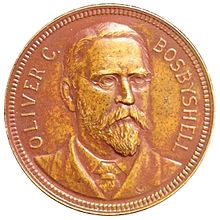
Three days before the signing of the 1890 act, Barber wrote to the superintendent of the Philadelphia Mint, Oliver Bosbyshell, setting forth proposed terms of a competition to select new coin designs. Barber suggested that entrants be required to submit models, as opposed to drawings, and that the designs exist in low relief, which was used for coins. He proposed that the entries include the lettering and denomination, as submissions without them would not fairly evidence the advent of the finished coin.[12] He received a reply that due to other work, the Mint would not be able to accost the question until the spring of 1891.[thirteen]
On Oct 16, 1890, a new Mint manager, Edward O. Leech, took office. Leech, anile 38 at the time, had spent his career at the Bureau of the Mint, and was an enthusiastic supporter of redesign. He took the precaution of obtaining recommendations from Barber as to suitable outside artists who might participate in a competition. Since most of the proposed artists were New York-based, Andrew Mason, superintendent of the New York Assay Office, was given the job of finalizing the list of invitees. Leading Bricklayer'due south list of ten names was that of Saint-Gaudens.[14] Mason sent Leech the recommendations on April 3, 1891; the following solar day, the Mint managing director announced the competition, open up to the public, but he specifically invited the ten artists named by Mason to participate. Also Saint-Gaudens, artists asked to compete included Daniel Chester French, Herbert Adams and Kenyon Cox. Although Barber had warned the director that reputable artists would likely not enter a contest in which only the winner received compensation, Leech offered a $500 prize to the winner, and no payments to anyone else. He sought new designs for both sides of the dollar, and for the obverses of the one-half dollar, quarter, and dime—Leech was content to let the reverses of the Seated Liberty coins proceed.[fifteen] By police, an eagle had to appear on the quarter and half dollar, just could not appear on the dime.[16]
Nigh of the artists conferred in New York and responded in a articulation alphabetic character that they would be willing to participate, but not on the terms set. They proposed a competition with set up fees for sketches and designs submitted by the invited artists, to be judged by a jury of their peers, and with the Mint committed to replace the Seated Liberty coins with the result. They likewise insisted that the same artist create both sides of a given coin, and that more time be given to allow the evolution of designs.[17] Leech was unable to meet these terms, as at that place was just enough coin bachelor for the single prize. In add-on to inviting the ten artists, he had sent thousands of solicitations through the state; a number of designs were submitted in response to the circulars. To judge the submissions, he appointed a jury consisting of Saint-Gaudens, Barber, and Henry Mitchell, a Boston seal engraver and member of the 1890 Assay Commission. The committee met in June 1891 and quickly rejected all entries.[15]
Leech was quoted in the press regarding the result of the contest:
It is not likely that some other competition volition e'er be tried for the production of designs for United States coins. The one just concluded was too wretched a failure ... The outcome is not very flattering to the boasted artistic development of this state, inasmuch as only ii of the three hundred suggestions submitted were good plenty to receive honorable mention.[18]
Barber wrote years afterwards most the contest, "many [entries] were sent in, merely Mr. St. Gaudens, [sic] who was appointed one of the committee to pass upon designs, objected to everything submitted".[19] Numismatic historian Roger Burdette explained the artistic differences between the two men:
It is probable they were and so far apart in their artistic understanding that neither listened to what the other had to say ... Barber was from the English trades-apprentice approach where engraving and die sinking were crafts closely aligned to other metal workers such as car tool makers. His father and grandfather were both engravers. Saint-Gaudens was a classically trained sculptor who began his career as an apprentice cameo cutter in New York, later moving to Paris and Rome for all-encompassing grooming while perfecting his artistry. Barber generally worked in small, circular formats—a three-inch medal was a big size for his sculptures. Saint-Gaudens was uncomfortable with small medals and typically designed life-size or larger figures ... the 1891 contest turned the 2 against each other for the residuum of their lives.[19]
Preparation [edit]
Frustrated at the competition's event, Leech instructed Barber on June xi, 1891, to prepare designs for the half dollar, quarter, and dime. As the Morgan dollar was so being heavily struck, the Mint manager decided to go out that design unaltered for the time being. For the obverse of the new coins, Leech suggested a depiction of Freedom similar to that on the French coins of the menstruation; he was content that the current reverses be connected. Leech had previously suggested to Barber that he engage outside help if the work was to be washed at the Mint; the primary engraver replied that he was aware of no one who could be of help in the preparation of new designs. Leech had spoken with Saint-Gaudens on the same subject; the sculptor stated that merely four men in the world were capable of executing high-quality coin designs; 3 lived in France and he was the 4th.[20]

Barber'south offset obverse for the half dollar
Leech appear the decision to have Hairdresser do the work in July, stating that he had instructed the engraver to prepare designs for presentation to Secretary of the Treasury Charles Foster. In a letter printed in the New York Tribune, Gilder expressed disappointment that the Mint was planning to generate the new designs in-house, feeling that the Mint, essentially a factory for coins, was ill-equipped to generate creative coin designs. Due to Gilder'southward prominence in the coinage redesign motion, Leech felt the need to answer personally, which he did in early August. He told Gilder that "creative designs for coins, that would run across the ideas of an art critic like yourself, and artists generally, are not always adapted for practical coining".[21] He assured Gilder that the designs which Barber had already prepared had met with the approval of Mitchell, though Leech himself had some improvements to advise to the chief engraver.[22]
Barber's first endeavour, modeled for the one-half dollar, disregarded Leech'southward instructions. Instead of a design based on French coinage, it depicted a standing figure of Columbia, bearing a pileus (a crown fashioned from an olive branch) atop a liberty pole; an eagle spreading its wings stands behind her. The contrary utilized the heraldic eagle from the Not bad Seal of the United States, enclosed inside a thick oak wreath, with the required legends surrounding the rim.[a] Leech rejected the design, and Barber submitted a revised obverse in mid-September with a head of Liberty like to that on the adopted coin. Leech got feedback from friends and from Secretary Foster; on September 28, he wrote Barber that Freedom's lips were "rather voluptuous" and directed him to gear up a reverse without the wreath. Barber did then, and design coins based on the revised design were struck. Barber complained, in a letter on October 2 to Superintendent Bosbyshell, but intended for Leech, that the constant demands for changes were wasting his time.[23] [24] Leech replied, stating that he did not intendance how much effort was expended in order to improve the design, specially since, once issued, they would take to exist used for 25 years. Barber'due south respond was transmitted to Leech on October 6 with a cover letter from Acting Superintendent Mark Cobb (Bosbyshell was traveling) stating that Barber "disclaims any intention to be captious and certainly did not intend to question your prerogative as one of the officers designed by police force to pass upon new designs for coinage".[25] [26] The letter from Hairdresser was a lengthy technical explanation for various design elements, and requested farther communication from Leech if he had preferences; the overall tone was argumentative. Leech chose non to write once more; he addressed one concern, about whether the olive branches in the design were rendered accurately, by visiting the National Botanical Garden, obtaining one, and sending it to Barber.[13] [25]
A Hairdresser coinage pattern opposite, with wreaths and clouds
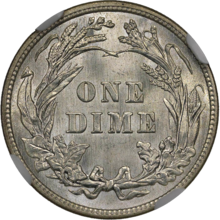
The question of how to render the stars (representing the 13 original states) on the coin was posed in the messages;[27] in the end, Leech opted for six-pointed stars on the obverse and five-pointed ones on the opposite. Barber had prepared three versions of the blueprint, each with clouds over the eagle; Leech approved one on October 31 and ordered working dies prepared, but then began to question the presence of the clouds, and had two more versions made. On Nov six, President Harrison and his Cabinet considered which of the designs to corroborate, and chose one without the clouds; the following day, Leech ordered working dies prepared. Barber scaled down his design for the quarter and dime.[28] While the Cabinet canonical the designs, members requested that the Mint embolden the words "Liberty" on the obverse and "E Pluribus Unum" on the opposite, believing that these legends would wear away in circulation; despite the resulting changes, this proved to be authentic.[13] For the reverse of the dime, on which, past police, an hawkeye could not announced, a slight modification of the reverse of the Seated Liberty dime was used, with a wreath of leafage and produce surrounding the words "One Dime".[29] [16]
It is uncertain when pattern dimes and quarters were struck, merely this was most likely in mid-Nov 1891. One variety each of design dime and quarter are known, whereas five different half dollars are extant; all known Barber coin patterns are in the National Numismatic Drove and none are in private easily. On December 11, Bosbyshell requested a delay in production to mid-January 1892 to allow the dies to be more thoroughly tested; Leech refused. The get-go Barber coins were struck at the Philadelphia Mint on Jan 2, 1892, at 9:00 a.grand. By the end of the day, all three denominations had been coined.[13] [30]
Design [edit]

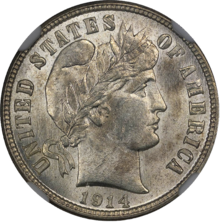
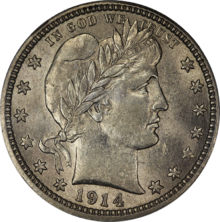
All iii denominations of the Hairdresser coinage draw a head of Liberty, facing right. She wears a pileus and a small headband inscribed "Liberty". On the quarter and half dollar, the motto "In God We Trust" appears to a higher place her head; she is otherwise surrounded with 13 six-pointed stars and the date. On the dime, her head is surrounded with "United States of America" and the yr. The reverse of the quarter and the half dollar depicts a heraldic hawkeye, based on the Great Seal. The bird holds in its mouth a scroll inscribed "E Pluribus Unum" and in its right claws an olive branch; in its left it holds 13 arrows. Above the hawkeye are 13 five-pointed stars; information technology is surrounded past the name of the country and by the coin's denomination.[31] The reverse of the dime depicts a wreath of corn, wheat, maple and oak leaves surrounding the words "One Dime".[29] Barber'due south monogram "B" is on the cutoff of Liberty's cervix; the mint mark, on the dime, is placed beneath the wreath on the reverse[32] and below the eagle on the larger denominations.[33]
Barber's caput of Liberty is purely classical, and is rendered in the Roman style. The head is modeled after the French "Ceres" silver coinage of the late 19th century, simply bears a resemblance to Morgan's blueprint for the silver dollar.[34] This did not escape numismatist Walter Breen in his comprehensive guide to U.Due south. coins: "Barber must take been feeling unusually lazy. He left the [dime] rev[erse] design equally it had been since 1860, with small simplifications. His obv[erse] was a mirror image of the Morgan dollar head, with much of Miss Anna Willess Williams'[b] dorsum hair cropped off, the rest concealed ... within a disproportionately big cap."[35] In his text introducing the Barber quarter, Breen states, "the whole limerick is Germanically stolid, prosy, crowded (peculiarly on rev[erse]), and without discernible merit bated from the technical one of low relief".[36] Burdette terms Barber'southward designs, "typically mediocre imitations of the current French-style—hardly better than the arcane seated Liberty blazon they replaced".[19]
Art historian Cornelius Vermeule, in his piece of work on U.Southward. coins, took a more positive view of Barber's coinage: "the last give-and-take every bit to their aesthetic merits has still to be written. Little admired or collected for more than 3 generations after their appearance [writing in 1971], these substantially conservative only most dignified coins have suddenly get extremely popular with collectors".[37] Vermeule argued that "the designs of Barber's coins were more attuned to the times than he perhaps realized. The plumpish, matronly gravitas of Liberty had come to America seven years earlier in the person of Frédéric Bartholdi'due south giant statue [the Statue of Freedom] ... "[38] He suggested that the features of Daniel Chester French's huge statue Republic, created for the World Columbian Exposition, "were admittedly in harmony with what Charles Barber had created for the coinage in the twelvemonth of the Fair's opening".[38]
Reception [edit]

Charles Eastward. Hairdresser, his argent coins met mixed reviews, but were the pocket change of generations
Leech released the new designs to the press about November x, 1891.[13] According to numismatist David Lange, the new coinage received mixed reviews: "while the full general press and public seemed satisfied with the new dime, quarter dollar, and half dollar, numismatists were either mildly disappointed with the new coins or remained silent on the matter."[34] Moran records a number of unfavorable reviews, without list any favorable ones.[28] Vermeule stated that "the initial comment on the new coinage concerned the novelty of a contest, its failure, and the inevitable result that the commission would go, every bit always, to the Chief Engraver [Barber] and his staff."[39]
George Heath, editor of The Numismatist, discussed the new pieces: "the mechanical work is all that could be desired, and it is probable that owing to the conventional rut in which our mint regime seem obliged to keep, this is the best that could be done".[34] West.T.R. Martin wrote in the American Journal of Numismatics, "The general event is pleasing, of the three the Dime is to many the near attractive piece. The head of Liberty is dignified, but although the dizzy story has been started that the contour is that of a 'reigning belle' of New York, she can hardly be called a beauty; there is a suggestion ... of the classic heads on some of the Roman coins, and a much stronger proposition of the head on the French Francs of 1871 and onward ... these coins are an advance on what has hitherto been accomplished, just there is yet a long distance between them and the platonic National coin."[40]
Other reactions were unfavorable. Artist Kenyon Cox, one of the invited artists to the 1891 competition, stated, "I think it disgraceful that this great country should have such a money equally this."[41] Harper'southward Weekly proclaimed, "The mountain had labored and brought forth a mouse."[28] Saint-Gaudens was besides interviewed, and every bit author Moran put it, "injudiciously ranted": "This is inept; this looks similar it had been designed by a young lady of sixteen, a miss who had taken only a few lessons in modeling. Information technology is beneath criticism ... There are hundreds of artists in this state, whatever of whom, with the aid of a designer, could have fabricated a very respectable coin, which this is not."[42]
Production and collecting [edit]

Soon afterwards issuance of the new quarters, the Mint received complaints that they would not stack properly. Barber fabricated adjustments in his design to remedy this problem. Appropriately, in that location are two versions of the 1892 quarter, dubbed "Blazon I" and "Blazon II", both for the version without mint mark struck at Philadelphia and for those struck at the New Orleans Mint (1892-O) and the San Francisco Mint (1892-S). They may be distinguished by their reverses: Type I quarters have about one-half of the letter "East" in "UNITED" covered by the hawkeye'southward wing; with Type II quarters, the letter is virtually entirely obscured. Type I quarters are rarer for each mint.[xiii] [43]
The 1894-S Barber dime is ane of the nifty numismatic rarities, with a published mintage of 24 proof pieces. Various stories attend the question of how so few came to be coined. According to Nancy Oliver and Richard Kelly in their 2011 article for The Numismatist, the San Francisco Mint in June 1894 needed to coin $2.xl in silverish left over from the melting of worn-out coins, just plenty to coin 24 dimes. More than ten-cent pieces were expected to be struck there later in the year, but this did non occur.[44] Breen, on the other mitt, related that San Francisco Mint Superintendent John Daggett had the dimes struck for a group of banker friends, giving three to each. He also gave three to his young daughter Hallie, telling her to retain them until she was equally old equally he was, and she would be able to sell them for a expert price. Co-ordinate to the story, she spent one on a dish of ice foam, but kept the other two until 1954. One of the approximately nine known dimes was retrieved from circulation in 1957, and Breen speculated this may have been the water ice foam specimen.[45] One sold for $1,552,500 at auction in 2007.[32]
In 1900, Barber modified the dies. This modify resulted in quarters that were thinner, so that 21 of the new coins would stack in the infinite occupied by 20 of the old. Barber again set to piece of work on the dies. San Francisco Mint officials wanted permission to utilise the old dies, which was refused, equally information technology was felt that all mints should exist producing coins with the same specifications. There are pocket-sized differences between quarters produced at the different mints.[46]
Except for the 1894-S dime, there are no smashing rarities in the Hairdresser series, as mintages were by and large adequate to high. Fundamental dates for the dime include the 1895-O (with the lowest mintage), 1896-S, 1897-O, 1901-Southward and 1903-S. For the quarter, key dates are the very low mintage 1896-Due south, 1901-S, and 1913-South issues, with the 1901-S particularly scarce.[47] The rarest half dollar is the 1892-O "Micro O", in which the mint mark "O" for New Orleans was impressed on the half dollar dice with a puncheon intended for the quarter; other key dates are the regular 1892-O, 1892-S, 1893-Due south, 1897-O, 1897-Due south, 1913, 1914, and 1915. The last three dates accept very low mintages but were preserved in substantial numbers. Every bit half dollars were heavily circulated, prices tend to steeply ascent for all coins in higher grades. "Condition rarities", relatively common and inexpensive in circulated condition but plush in high grades, include the 1901-S, 1904-Southward, and 1907-S half dollars.[48] [49] Thus, although near dates are easily obtainable, many are scarce in college and uncirculated grades. Also, in 1909, a new one-half dollar hub was introduced, which fabricated the headband word "Liberty" stronger, thus changing a grading diagnostic.[50] Earlier Barber halves are frequently separately graded for their obverse and reverse characteristics, as the reverse tended to vesture faster. Finally, large quantities of lower class Barber coins were melted for bullion when argent prices rose in 1979 and early 1980.[51]

1903 proof status Barber quarter
Replacement [edit]

According to Burdette, "agitation to replace Barber's banal 1892 Liberty head began almost before the start coins were cold from the press."[52] In 1894, the American Numismatic and Antiquarian Society, in conjunction with various artistic and educational institutes, began to abet for better designs for U.S. coins, but no change took identify in the remainder of the 19th century.[53] [54]
In 1904, President Theodore Roosevelt started to push for improvements to U.South. coins, and arranged for the Mint to engage Saint-Gaudens to redesign coins which could be changed under the 1890 act. Before his death in 1907, the sculptor provided designs for the double eagle and eagle, though the double hawkeye required adjustment by Barber to lower the relief before it could be released equally a circulating coin.[55] [56] Redesign of the smaller golden pieces, Lincoln cent, and Buffalo nickel followed between 1908 and 1913. By then, the dime, quarter, and half dollar were the only coins existence struck[c] which had not received a redesign in the 20th century. Equally the 1916 engagement approached when the Hairdresser coins could be changed without an act of Congress, calls for a new design increased.[52]
In 1915, a new Mint director, Robert W. Woolley, took office. Woolley advocated the replacement of the silvery coins when it was legal to do so, and instructed Barber and Morgan to prepare new designs. He consulted with the Commission of Fine Arts, asking them to examine the designs produced by the Mint'southward engravers and, if they felt they were not suitable, to recommend artists to pattern the new coins. The Commission rejected the Barber and Morgan designs and proposed Adolph Weinman, Hermon MacNeil, and Albin Polasek as designers. Although Woolley had hoped that each artist would produce one blueprint, dissimilar concepts past Weinman were accepted for the dime and half dollar, and one past MacNeil for the quarter.[57]
Woolley had hoped to begin production of the new coins on July 1, 1916. There was heavy demand for small modify,[58] and as delays in actual product stretched into the second half of the year, Woolley was forced to have Barber prepare dies for 1916-dated dimes and quarters bearing the chief engraver'southward 1892 blueprint. According to numismatist David Lange, "Hairdresser must have secretly smiled to himself every bit his familiar Roman bust of Liberty one time again dropped from the presses by the thousands, and then by the millions."[57] At that place were sufficient half dollars from 1915 available to run into demand; no Barber halves were struck in 1916.[57] [49] The product difficulties were eventually ironed out, and at least token quantities of each of the new coins were struck in 1916, putting an cease to the Barber coinage series.[59]
Notes [edit]
- ^ Hairdresser later reused the design, in combination with a reverse by Morgan, in a proposed double hawkeye; instead a blueprint past Saint-Gaudens was used. Meet Burdette 2006, p. 247.
- ^ The schoolteacher who modeled for the Morgan dollar. Meet Breen, p. 443.
- ^ The Morgan dollar had not so been struck since 1904. Encounter Yeoman, p. 226.
References [edit]
- ^ Money World Almanac, p. 215.
- ^ Moran, p. 53.
- ^ Moran, pp. 54, 57.
- ^ Moran, p. 57.
- ^ Bowers 2006, p. 140.
- ^ Montgomery, Borckardt & Knight, p. 29.
- ^ a b Moran, p. 43.
- ^ Taxay, p. 285.
- ^ Yeoman, p. 226.
- ^ Moran, pp. 43–44.
- ^ Moran, pp. 45–50.
- ^ Burdette 2006, pp. nine–10.
- ^ a b c d e f Julian.
- ^ Moran, p. 58.
- ^ a b Moran, pp. 59–61.
- ^ a b Bureau of the Mint, p. 55.
- ^ Taxay, p. 287.
- ^ Taxay, p. 288.
- ^ a b c Burdette 2006, p. 11.
- ^ Moran, pp. 61–62.
- ^ Moran, pp. 62, 65.
- ^ Moran, p. 65.
- ^ Moran, pp. 65–66.
- ^ Taxay, p. 289.
- ^ a b Moran, pp. 66–67.
- ^ Taxay, pp. 289–290.
- ^ Taxay, pp. 289–294.
- ^ a b c Moran, p. 67.
- ^ a b Breen, pp. 315, 322–323.
- ^ Gilkes, p. l.
- ^ Lange, pp. 134–135.
- ^ a b Yeoman, p. 155.
- ^ Yeoman, pp. 171, 206.
- ^ a b c Lange, p. 134.
- ^ Breen, p. 322.
- ^ Breen, p. 358.
- ^ Vermeule, p. 87.
- ^ a b Vermeule, p. ninety.
- ^ Vermeule, p. 67.
- ^ Vermeule, pp. 89–90.
- ^ Moran, pp. 59, 67.
- ^ Moran, pp. 67–68.
- ^ Breen, pp. 358–359.
- ^ Oliver & Kelly, p. 99.
- ^ Breen, p. 323.
- ^ Feigenbaum, History of the Hairdresser Series.
- ^ 1901-S Barber Quarter
- ^ Guth & Garrett, pp. 62, 76, 92.
- ^ a b Yeoman, pp. 205–207.
- ^ Circulated Barber Half Dollars – A Await Dorsum at Two Decades of Specialization
- ^ Taylor.
- ^ a b Burdette 2005, p. 13.
- ^ Taxay, p. 294.
- ^ Lange, p. 136.
- ^ Lange, pp. 136–137.
- ^ Burdette 2006, p. 105.
- ^ a b c Lange, History of the Mercury dimes.
- ^ Burdette 2005, p. 14.
- ^ Lange, p. 150.
Bibliography
- Bowers, Q. David (2006). A Guide Book of Shield and Liberty Caput Nickels. Atlanta, Ga.: Whitman Publishing. ISBN978-0-7948-1921-7.
- Breen, Walter (1988). Walter Breen'southward Consummate Encyclopedia of U.South. and Colonial Coins. New York, North.Y.: Doubleday. ISBN978-0-385-14207-6.
- Burdette, Roger West. (2005). Renaissance of American Coinage, 1916–1921. Great Falls, Va.: Seneca Factory Printing. ISBN978-0-9768986-0-3.
- Burdette, Roger W. (2006). Renaissance of American Coinage, 1905–1908. Great Falls, Va.: Seneca Manufacturing plant Printing. ISBN978-0-9768986-1-0.
- Agency of the Mint (1904). Laws of the Usa Relating to the Coinage. Washington, D.C.: U.s. Authorities Printing Office.
- Coin World Annual (3rd ed.). Sidney, Ohio: Amos Press. 1977. ASIN B004AB7C9M.
- Guth, Ron; Garrett, Jeff (2005). United states Coinage: A Written report past Type. Atlanta, Ga.: Whitman Publishing. ISBN978-0-7948-1782-4.
- Lange, David W. (2006). History of the U.s. Mint and its Coinage. Atlanta, Ga.: Whitman Publishing. ISBN978-0-7948-1972-9.
- Montgomery, Paul; Borckardt, Mark; Knight, Ray (2005). Meg Dollar Nickel. Irvine, Ca.: Zyrus Press. ISBN978-0-9742371-viii-three.
- Moran, Michael F. (2008). Striking Change: The Great Artistic Collaboration of Theodore Roosevelt and Augustus Saint-Gaudens. Atlanta, Ga.: Whitman Publishing. ISBN978-0-7948-2356-6.
- Taxay, Don (1983). The U.Southward. Mint and Coinage (reprint of 1966 ed.). New York, N.Y.: Sanford J. Durst Numismatic Publications. ISBN978-0-915262-68-7.
- Vermeule, Cornelius (1971). Numismatic Art in America . Cambridge, Mass.: The Belknap Press of Harvard University Printing. ISBN978-0-674-62840-3.
- Yeoman, R.South. (2014). A Guide Book of United States Coins (68th ed.). Atlanta, Ga.: Whitman Publishing. ISBN978-0-7948-4215-iv.
Other sources
- Feigenbaum, David Lawrence; Feigenbaum, John (September 29, 1999). "The Complete Guide to Certified Barber Coinage. Chapter 1: History of the Hairdresser Series". DLRC Press. Archived from the original on March 12, 2013. Retrieved Feb 13, 2012.
- Gilkes, Paul (September 3, 2012). "Don't ignore Barber dimes". Coin Globe. Sidney, Ohio: Amos Press. 53 (2734): 46, 48, 50–51.
- Julian, R.W. "Barber Coinage". CollectorUSA. Archived from the original on August 21, 2013. Retrieved September 13, 2012.
- Lange, David (January nine, 2005). "Mercury dimes. Chapter ane: History of the Mercury dimes". DLRC Press. Archived from the original on Baronial 12, 2012. Retrieved September sixteen, 2012.
- Oliver, Nancy; Kelly, Richard (May 2011). "The 1894-S dime". The Numismatist. Colorado Springs, Co.: American Numismatic Association: 99–100.
- Taylor, Sol (August 20, 2005). "Hairdresser's silver coinage: fun serial to collect". Santa Clarita Valley Historical Club. Retrieved September 15, 2012.
External links [edit]
- CoinCommunity.com - United states of america Barber Coinage Information
castellanosifeenchall.blogspot.com
Source: https://en.wikipedia.org/wiki/Barber_coinage
0 Response to "How Do You Know if You Have a Real Barbra Half Dollar"
Postar um comentário